Yoga Nidra vs. NSDR: The Neuroscience of Non-Sleep Deep Rest

Yoga Nidra and Non-Sleep Deep Rest (NSDR) utilize identical underlying neurobiological mechanisms to induce profound physiological restoration while maintaining conscious awareness, differing primarily in their framing, cultural lineage, and philosophical depth:
- The Neurobiological Core: Both practices guide the brain from active beta states into hypnagogic alpha and theta wave synchrony, downregulating sympathetic arousal and activating the parasympathetic vagal brake.
- The Striatal Dopamine Mechanism: Clinical neuroimaging demonstrates that passive sensory surrender during Yoga Nidra increases endogenous dopamine release in the ventral striatum by up to 65%, replenishing baseline cognitive drive without chemical stimulants.
- Lineage vs. Secular Framing: Classical Yoga Nidra is an ancient Indian contemplative science structured around the 5 Koshas and personal intention (Sankalpa), whereas NSDR is a modern, secular umbrella protocol developed by Dr. Andrew Huberman for focus reset, neuroplasticity, and sleep debt recovery.
Yoga Nidra vs. NSDR at a Glance
| Feature / Dimension | Classical Yoga Nidra (योग निद्रा) | Non-Sleep Deep Rest (NSDR) |
|---|---|---|
| Historical Origin | Ancient Indian yogic traditions (Mandukya & Taittiriya Upanishads); systematized by Swami Satyananda Saraswati in the 20th century. | Coined in the 2020s by Stanford neuroscientist Dr. Andrew Huberman. |
| Core Framework | Systematic 8-stage contemplative methodology moving through the 5 Koshas (sheaths of consciousness). | Broad, secular umbrella protocol including guided body scans, physiological sighs, and self-hypnosis. |
| Framing & Terminology | Traditional Sanskrit terminology (Sankalpa, Nyasa, Pratyahara, Chidakasha, Dvandva). | Secular, clinical, and physiological language (vagal tone, down-regulation, cortical de-excitation). |
| Primary Mechanism | Shifting brainwaves into theta/delta while retaining witness consciousness (Sakshi). | Down-regulating autonomic arousal from sympathetic to parasympathetic dominance. |
| Role of Intention | Central integration of Sankalpa—a resolve planted deep into the subconscious mind to alter identity. | Optional cognitive focus or mental reset; primarily emphasizes physiological restoration and learning acceleration. |
| Neurochemical Impact | Documented up to 65% increase in baseline striatal dopamine release; elevation of GABA and melatonin. | Dopamine replenishment, reduction in circulating cortisol and epinephrine, upregulation of acetylcholine during post-learning. |
| Spiritual Dimension | Transcending the ego-mind to rest in unconditioned, self-luminous awareness (Turiya). | Strictly secular and physiological; zero metaphysical, energetic, or spiritual philosophy. |
| Typical Posture | Supported Shavasana (Corpse Pose) with head and knees aligned on a natural mat. | Reclined flat on back or seated supported in an ergonomic chair with eyes closed. |
The Neuroscience of Non-Sleep Deep Rest
Whether approached through classical Sanskrit scriptures or modern neuroimaging, both Yoga Nidra and NSDR navigate the human brain into a unique hypnagogic boundary state—the precise liminal territory between active wakefulness and slow-wave sleep.
1. Brainwave Transitions: From High Beta to Delta Synchrony
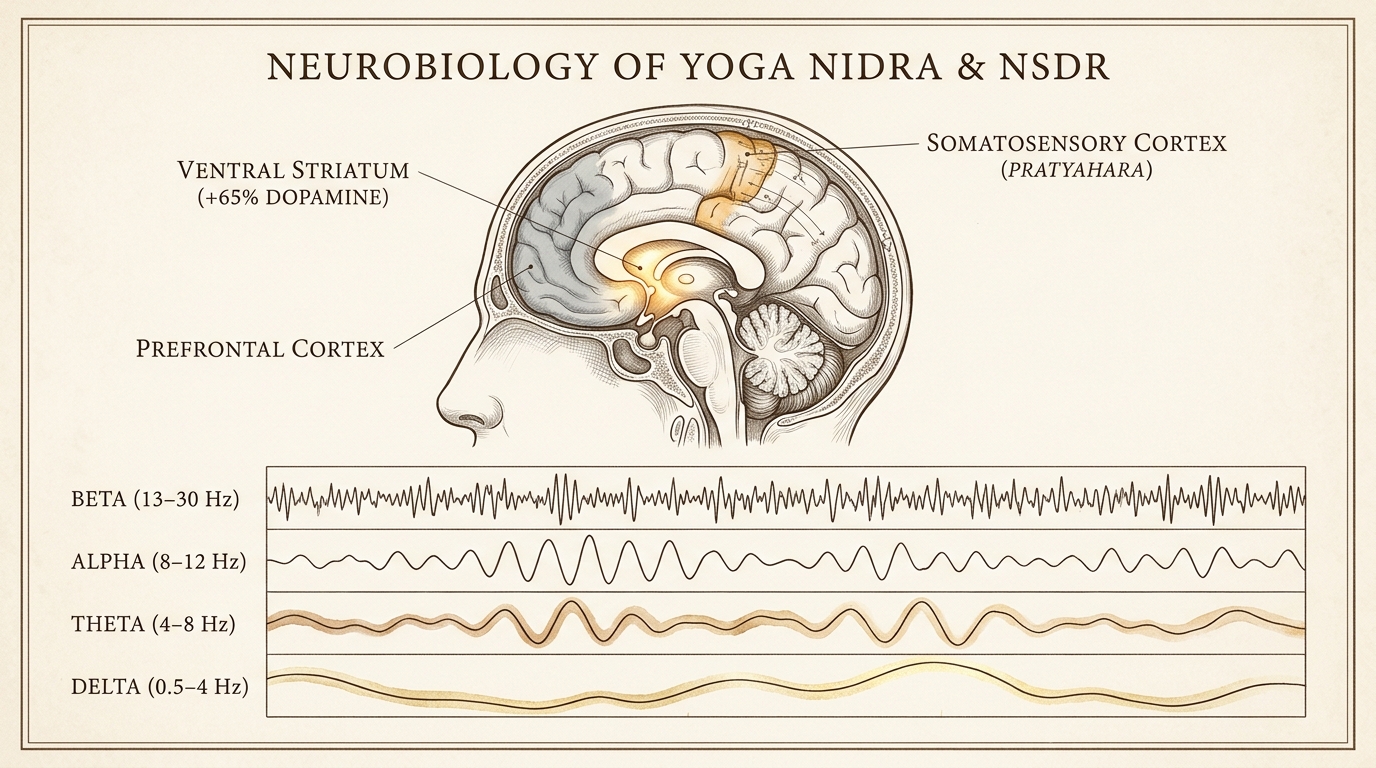
In normal waking life, the adult human brain operates primarily in Beta frequencies (13–30 Hz), reflecting active sensory processing, analytical problem-solving, cognitive evaluation, and stress responses. When you lie down and listen to a structured guided rotation of consciousness, your brain undergoes a rapid, sequential down-shift in electrical oscillations:
| Brainwave Band | Frequency Range | Neuro-Cognitive & Physiological State |
|---|---|---|
| High Beta (β) | 20 – 30 Hz | Analytical stress, mental rumination, and active sympathetic vigilance. |
| Mid/Low Beta (β) | 13 – 20 Hz | Alert problem-solving, everyday task focus, and external sensory processing. |
| Alpha Waves (α) | 8 – 12 Hz | Sensory gating, relaxed alertness, and the bridge between waking and subconscious mind. |
| Theta Waves (θ) | 4 – 8 Hz | Hypnagogic dream-wake threshold, memory consolidation, neuroplasticity, and deep restorative state. |
| Delta Waves (δ) | 0.5 – 4 Hz | Slow-wave physical rejuvenation and cellular repair experienced while maintaining witness consciousness (Sakshi). |
- Alpha Waves (8–12 Hz): The moment external visual input ceases and you close your eyes, the occipital lobe begins generating synchronized alpha oscillations. Alpha acts as an attentional gating mechanism, dampening incoming sensory noise and calming the central nervous system.
- Theta Waves (4–8 Hz): As the voice guides your awareness through body parts without physical movement, the brain transitions into theta. This is the hypnagogic state—the twilight zone where dreams originate while the intellect rests. Neurologically, theta oscillations are directly correlated with accelerated memory consolidation, heightened synaptic plasticity, and spontaneous creative insight.
- Local Slow Waves / Delta (0.5–4 Hz): In landmark quantitative EEG (qEEG) studies conducted on advanced yoga practitioners, researchers observed the appearance of slow Delta waves typically reserved for deep Stage 3 and Stage 4 non-REM sleep. Remarkably, while parts of the cerebral cortex exhibited sleep-like delta synchronization, the sensory areas remained responsive to the verbal guidance—confirming that the practitioner was simultaneously asleep and consciously awake.
2. Autonomic Nervous System Regulation: Engaging the Vagal Brake
Modern urban life places the autonomic nervous system under persistent, low-grade sympathetic activation ("fight-or-flight"). In this state, elevated cortisol, increased heart rate, and chronic muscle bracing deplete cellular energy stores.
Yoga Nidra and NSDR serve as an immediate bottom-up physiological brake:
- Vagus Nerve Activation: Slow diaphragmatic breathing and prolonged exhalations stimulate the afferent fibers of the vagus nerve (cranial nerve X), dispatching signals to the cardiac pacemaker cells (sinoatrial node) to slow heart rate and lower arterial blood pressure.
- Parasympathetic Dominance: As the parasympathetic nervous system ("rest-and-digest") takes over, circulating catecholamines (epinephrine and norepinephrine) plummet. Heart rate variability (HRV) increases, signaling optimal autonomic flexibility.
- Glycogen & ATP Replenishment: By eliminating physical muscular contraction while maintaining oxygenated respiration, cellular tissues replenish adenosine triphosphate (ATP) and rebalance endocrine signaling.
To explore the clinical mechanics of diaphragmatic pacing and vagal regulation, read our masterclass on The Science of Pranayama & Vagus Nerve Stimulation.
3. Striatal Dopamine Restoration: The PET Scan Breakthrough
Seated mindfulness meditation—such as Vipassana or focused-attention breath observation—requires sustained top-down attentional effort. While mindfulness effectively strengthens executive control in the prefrontal cortex and influences serotonin networks, it does not restore dopamine in the basal ganglia.
In contrast, Yoga Nidra and NSDR operate through effortless sensory surrender.
A landmark 2002 PET (Positron Emission Tomography) scan study published by Dr. Troels Kjær and colleagues in Cognitive Brain Research (PubMed: Striatal Dopamine Release During Altered States of Consciousness) evaluated experienced practitioners during Yoga Nidra using $[^{11}\text{C}]\text{raclopride}$ radiotracers:
Clinical Finding: During Yoga Nidra, binding potential of raclopride dropped significantly in the ventral striatum, demonstrating an astounding 65% increase in endogenous dopamine release.
| Neurotransmitter / Hormone | Directional Shift | Physiological & Behavioral Impact |
|---|---|---|
| Striatal Dopamine | ▲ +65% Increase | Replenishes baseline motivation, mental stamina, and cognitive readiness without post-stimulant crashes. |
| GABA (Gamma-Aminobutyric Acid) | ▲ Significant Elevation | Primary inhibitory neurotransmitter; dampens cortical hyper-excitability and terminates anxious rumination. |
| Melatonin | ▲ Enhanced Secretion | Potent endogenous antioxidant; supports mitochondrial recovery and cellular repair across tissues. |
| Cortisol | ▼ -30% to -50% Reduction | Alleviates chronic systemic inflammation, vascular tension, and hypothalamic-pituitary-adrenal (HPA) axis strain. |
| Norepinephrine & Epinephrine | ▼ Systematically Suppressed | Shuts down peripheral vasoconstriction and dissolves involuntary spinal muscle guarding. |
The ventral striatum is the hub of the brain’s reward and motivation circuitry. When you are sleep-deprived, mentally burned out, or exhausted from cognitive strain, baseline dopamine levels become severely depleted. Yoga Nidra and NSDR naturally regenerate striatal dopamine reservoirs without the neurochemical crash associated with caffeine or pharmaceutical stimulants.
4. Pratyahara and the Cortical Homunculus
In classical Raja Yoga, the fifth limb is known as Pratyahara—the conscious withdrawal of sensory attachments (indriyas).
In traditional Yoga Nidra, Pratyahara is achieved through rapid rotation of consciousness (Nyasa): systematically guiding awareness through the right thumb, second finger, palm, wrist, forearm, elbow, shoulder, armpit, waist, hip, and down to the toes before repeating on the left side.
Neurologically, this sequence matches the Penfield Cortical Homunculus—the topographical sensory map of the human body arrayed across the primary somatosensory cortex (postcentral gyrus):
- Cortical Desaturation: Hands, lips, tongue, and fingers possess disproportionately massive representations in the sensory cortex. By rapidly moving awareness through these dense neurological hubs without lingering, the motor and premotor cortices cannot initiate action, and the sensory cortex becomes systematically disengaged.
- Quieting the Default Mode Network (DMN): The Default Mode Network (including the medial prefrontal cortex and posterior cingulate cortex) is responsible for narrative self-referential thought, future anxiety, and past regrets. Because attention is guided too rapidly for the brain to spin personal narratives, the DMN goes offline, inducing profound mental stillness (Chitta Vritti Nirodha).
To understand how silencing mental loops breaks chronic cognitive stress, review our guide on How to Stop Overthinking: Secrets of Yogic Mind Mastery.
How NSDR & Yoga Nidra Differ from Seated Meditation
Many practitioners mistakenly categorize NSDR and Yoga Nidra as identical to seated mindfulness or Vipassana meditation. While both train awareness, their neuro-architectural demands and clinical applications are distinctly different:
| Parameter | Seated Mindfulness Meditation (Dhyana) | Yoga Nidra & NSDR |
|---|---|---|
| Physical Posture | Upright seated posture (Padmasana, Siddhasana, Sukhasana) requiring tonic spinal stabilization. | Completely supine (Shavasana) or fully supported reclined posture eliminating spinal muscle activation. |
| Cognitive Effort | Active, top-down attentional control. Requires noticing mind-wandering and actively re-anchoring awareness. | Passive, bottom-up surrender. Requires zero effort; the practitioner simply yields to the auditory guidance. |
| Dominant Brainwave Band | Stable Alpha (8–12 Hz) with intermittent Beta spikes during attentional correction. | Deep Theta (4–8 Hz) and synchronized local Delta slow waves (0.5–4 Hz). |
| Dopamine vs. Serotonin | Predominantly modulates serotonin and prefrontal executive circuits. | Induces massive (+65%) endogenous dopamine replenishment in the ventral striatum. |
| Primary Risk Factor | Can induce physical fatigue, postural strain, or frustration in sleep-deprived individuals. | Risk of falling asleep if the nervous system has a severe accumulated sleep debt. |
| Best Clinical Use Case | Developing attentional endurance, emotional non-reactivity, and long-term metacognition. | Emergency nervous system recovery, cognitive burnout, sleep deprivation reset, and motor skill consolidation. |
The 8 Classical Stages of Yoga Nidra: Ancient Lineage Meets Clinical Design
While modern NSDR scripts typically focus on a 10-to-20-minute body scan combined with double inhales (physiological sighs), classical Yoga Nidra is an 8-stage transformative technology systematized by Swami Satyananda Saraswati of the Bihar School of Yoga:
| Stage Number & Sanskrit Title | Classical Yogic Focus | Modern Neuro-Physiological Correlate |
|---|---|---|
| Stage 1: Preparation (Arambha) | Supine symmetry in Shavasana, physical stillness, sensory acceptance. | Somatosensory stabilization, withdrawal of motor output, occipital alpha induction. |
| Stage 2: Initial Sankalpa | Planting an intentional resolve deep into subconscious Chitta. | Bypassing prefrontal critical filters during alpha-theta transition. |
| Stage 3: Rotation of Consciousness (Anga Nyasa) | Rapid mental movement across 70+ specific anatomical points. | Systematically disengaging the Penfield Cortical Homunculus and quieting the DMN. |
| Stage 4: Breath Awareness (Pranayama) | Reverse numerical breath counting at nostrils or navel. | Activating autonomic vagal afferents and stabilizing focused theta oscillations. |
| Stage 5: Evocation of Opposites (Dvandva) | Experiencing heaviness/lightness, heat/cold, pain/pleasure. | Interhemispheric cross-talk, insular cortex calibration, emotional equanimity. |
| Stage 6: Archetypal Visualization (Chidakasha) | Rapid symbolic visualizations across the inner mental space. | Accessing non-conscious limbic memory stores; transmuting latent samskaras. |
| Stage 7: Final Sankalpa Reaffirmation | Re-stating the identical resolve in fertile subconscious soil. | Sealing synaptic remodeling; reinforcing neuroplastic identity shifts. |
| Stage 8: Externalization (Punar Agamana) | Stepwise sensory re-engagement with physical surroundings. | Gentle, grounded transition back to beta alertness without post-hypnagogic grogginess. |
1. Preparation (Arambha)
The practitioner settles into Shavasana, ensuring absolute physical warmth and symmetry. Complete muscular surrender at the base of the pelvis is essential—to release chronic pelvic tension prior to deep hypnagogia, see our clinical guide on The Biomechanics of Mula Bandha & Pelvic Floor Relaxation. Environmental sounds are accepted rather than resisted, establishing sensory non-reactivity.
2. The Sankalpa (The Sacred Intentional Resolve)
A concise, positive, present-tense affirmation (e.g., "I am grounded, clear, and resting in supreme health") is stated internally three times with deep emotional conviction. In beta state, affirmations are filtered out by the analytical intellect. In the hypnagogic alpha-theta state, the subconscious mind (Chitta) receives the Sankalpa like a fertile seed planted in deep soil.
3. Rotation of Consciousness (Anga Nyasa)
Based on the ancient Tantric ritual of Nyasa (placing sacred awareness into specific bodily points), the mind travels systematically through 70+ anatomical points in rapid succession. This neutralizes motor pathways and induces profound somatosensory relaxation.
4. Breath Awareness (Pranayama)
Consciousness shifts to the tactile sensation of breath at the nostrils, throat, chest, or navel, often paired with counting backwards from 27 or 54 down to 1. If the count is lost, the practitioner starts over from the beginning—sharpening non-attached vigilance without tension.
5. Evocation of Opposites (Dvandva)
The teacher prompts the practitioner to intensely evoke opposing sensory and emotional states:
- Extreme heaviness (Guruta) vs. weightless lightness (Laghuta)
- Freezing cold (Shita) vs. radiant heat (Ushna)
- Pain (Dukha) vs. unconditional pleasure (Sukha)
Neurologically, pairing opposing sensations establishes balance between the right and left brain hemispheres, training the amygdala and insular cortex to observe emotional swings with equanimity.
6. Archetypal Visualization (Chidakasha Dharana)
The practitioner visualizes rapid symbolic imagery across Chidakasha (the inner space behind closed eyes): a burning candle, a tranquil mountain lake, a golden temple at dawn, an endless ocean. This bypasses the conscious ego, releasing latent emotional impressions (samskaras) trapped in the unconscious reservoir.
7. Final Sankalpa Reaffirmation
Before externalizing, the identical Sankalpa is repeated three times with unshakable faith. Having dissolved cognitive resistance, the seed is anchored permanently into the subconscious architecture.
8. Externalization (Punar Agamana)
The senses are systematically reconnected to the physical environment: external sounds, the weight of the body on the floor, and gentle micro-movements of the fingers and toes, preventing post-hypnagogic disorientation.
The Pancha Kosha Model: Why Ancient Yogis Went Beyond the Physical Brain
Modern neuroscience views NSDR as a brain-focused protocol: dampening cortical activity and balancing autonomic tone. While classical yoga fully acknowledges these physiological effects, it conceptualizes the human being through the Pancha Kosha (Five Sheaths of Existence) outlined in the Taittiriya Upanishad:
| Kosha (Sheath of Existence) | Ancient Yogic Domain (Taittiriya Upanishad) | Modern Clinical & Neurobiological Equivalent |
|---|---|---|
| 1. Annamaya Kosha | The gross physical / anatomical body (Anna = food). | Musculoskeletal system, myofascial holding patterns, and peripheral proprioception. |
| 2. Pranamaya Kosha | The vital energetic sheath governing breath and prana. | Autonomic nervous system, cardiorespiratory coupling, and vagal tone. |
| 3. Manomaya Kosha | The sensory-emotional mind (Manas = cognitive processing). | Limbic circuitry, Default Mode Network (DMN), and reactive emotional rumination. |
| 4. Vijnanamaya Kosha | The sheath of higher intellect, discernment, and intuition (Buddhi). | Metacognitive witness awareness, prefrontal lucidity, and theta neuroplasticity. |
| 5. Anandamaya Kosha | The causal bliss body; innate unconditioned wholeness (Ananda). | Transcendent homeostasis, effortless presence, and pure awareness (Turiya). |
- Annamaya Kosha: Relaxed through complete physical stillness and muscular desensitization in Shavasana.
- Pranamaya Kosha: Regulated through rhythmic nostril awareness, equalizing subtle energetic channels (Nadis). To study how alternate nostril flows balance the brain, see our guide on Nadi Shodhana Pranayama: Ancient Science & Benefits.
- Manomaya Kosha: Calmed through the rapid rotation of consciousness and emotional equanimity exercises (Dvandva).
- Vijnanamaya Kosha: Awakened during archetypal visualizations, accessing intuition and creative lucidity free from logical limitation.
- Anandamaya Kosha: The deepest core of human consciousness—an untainted realm of spiritual bliss and stillness beyond space and time (Turiya).
NSDR and Accelerated Neuroplasticity: The Huberman Protocol
Stanford neuroscientist Dr. Andrew Huberman specifically championed NSDR because of its dramatic impact on motor learning and cognitive memory consolidation:
The 20-Minute Post-Learning Protocol
When you acquire a new complex skill—whether studying Sanskrit grammar, learning hands-on yoga adjustments, or analyzing complex financial models—the brain’s neural circuits do not form stable synaptic connections during the active practice itself. Synaptic remodeling occurs during periods of offline rest:
- Active Focus Spike: High-intensity learning releases acetylcholine and epinephrine, marking specific synapses for modification.
- Immediate NSDR Session (10–20 mins): Engaging in NSDR immediately following the learning block triggers rapid neural replay in the hippocampus and neocortex at up to 20 times normal speed.
- Dopamine Replenishment: Restores cognitive motivation, preventing the post-study mental slump and reinforcing long-term potentiation (LTP).
Which Practice Should You Choose?
Both methodologies deliver extraordinary restorative benefits. Use the following decision matrix to determine which practice best aligns with your daily routine:
| Practical Scenario & Objective | Recommended Protocol | Primary Clinical Justification |
|---|---|---|
| Post-Lunch Energy Slump (1:00 PM – 3:30 PM) | 10–20 Min NSDR Session | Rapidly downregulates sympathetic burnout and replenishes dopamine without grogginess or interfering with nocturnal sleep. |
| Deep Subconscious Habit & Identity Transformation | 30–45 Min Classical Yoga Nidra | Utilizes the Sankalpa in hypnagogic theta state to bypass conscious resistance and plant lasting neuro-cognitive intentions. |
| Accelerating Memory After Intense Study / Training | 15–20 Min NSDR Protocol | Induces accelerated hippocampal neural replay (up to 20x speed) to consolidate synaptic modifications and motor skills. |
| Emotional Catharsis, Trauma Recovery & Spiritual Healing | 45–60 Min Classical Yoga Nidra | Navigates through the Pancha Koshas and Dvandva (opposing sensations) to release stored samskaras within a sacred container. |
| Acute Sleep Debt & Total Exhaustion | Either Practice (30+ Minutes) | Yields verified restorative EEG synchrony and up to +65% striatal dopamine restoration to stabilize autonomic tone. |
Safety and Trauma-Informed Practice
While Yoga Nidra and NSDR are exceptionally safe for the vast majority of people, entering deep hypnagogic states can occasionally trigger distressing emotional material or mild dissociation in individuals with unresolved PTSD or severe psychiatric vulnerabilities:
- Keep Your Eyes Open or Dim: If closing your eyes triggers anxiety, practice with eyes soft and focused on a single point on the ceiling.
- Maintain Bodily Agency: Never feel trapped in complete stillness. If emotional discomfort arises, gently wiggle your toes, open your eyes, or sit upright.
- Trauma-Informed Guidance: Work with experienced yoga teachers who offer grounding cues rather than disorienting esoteric prompts.
Frequently Asked Questions (AEO & Search Schema)
1. What is the fundamental difference between Yoga Nidra and NSDR?
Yoga Nidra is an ancient Indian contemplative practice systematized into an 8-stage methodology that utilizes the Pancha Koshas (five sheaths of consciousness) and a Sankalpa (subconscious resolve) for holistic spiritual and emotional transformation. NSDR (Non-Sleep Deep Rest) is a secular, neuroscience-based term coined by Dr. Andrew Huberman that strips away spiritual language, focusing strictly on autonomic nervous system down-regulation, brainwave slowing, and dopamine restoration.
2. Can NSDR replace nighttime sleep?
No. While a 30-minute NSDR or Yoga Nidra session can produce restorative physiological effects equivalent to 2–3 hours of light sleep by replenishing striatal dopamine and clearing metabolic fatigue, it cannot substitute for natural non-REM slow-wave sleep or REM sleep. Nighttime sleep performs unique glymphatic brain detoxification, hormone secretion (such as human growth hormone), and immune system recalibration that waking hypnagogia cannot replicate.
3. What should I do if I fall asleep during Yoga Nidra or NSDR?
Falling asleep is completely natural and indicates that your body is carrying an acute sleep debt. While the formal goal of Yoga Nidra is to remain awake at the threshold of sleep (the hypnagogic edge), falling asleep is simply a biological signal of exhaustion. Over time, as your nervous system recovers its baseline vitality, you will naturally maintain lucidity throughout the session.
4. How does Yoga Nidra boost dopamine levels?
A landmark PET neuroimaging study published in Cognitive Brain Research (PubMed: 11958969) showed that during Yoga Nidra, endogenous dopamine release in the ventral striatum increased by up to 65%. Unlike stimulants that cause acute dopamine spikes followed by severe crashes, the passive sensory withdrawal of Yoga Nidra gently replenishes baseline dopamine reserves, restoring cognitive energy, drive, and mental clarity.
5. When is the best time of day to practice Yoga Nidra or NSDR?
The two most effective times are:
- The Post-Lunch Circadian Dip (1:00 PM – 3:30 PM): A 15- to 30-minute session resets the nervous system, clears afternoon brain fog, and prevents late-day burnout without disrupting nighttime sleep.
- Immediately Post-Learning: Practicing a 10- to 20-minute session immediately after studying a new skill accelerates synaptic consolidation and memory retention.
Master the Science of Conscious Rest at Samyut Yogashala Mysore
At Samyut Yogashala in Mysore, India, ancient contemplative technologies are taught with rigorous anatomical precision, physiological integrity, and reverent scriptural depth. Under the personal guidance of Yogacharya Aravind Prasad and our master faculty, you will explore the full continuum of human consciousness—from classical Hatha and Ashtanga Vinyasa to Pranayama, Yoga Nidra, and Vedantic philosophy.
Whether you are seeking to advance your personal sadhana or complete an authentic 200-Hour Yoga Teacher Training in Mysore, discover the transformative power of authentic lineage study:
- Explore our residential 200-Hour Ashtanga & Hatha Yoga Teacher Training in Mysore.
- Read our comprehensive analysis on The Science of Pranayama & Vagus Nerve Stimulation.
- Discover how the central nervous system de-escalates in Why Your Spine Holds onto Old Emotional Pain.
- Discover safe pelvic floor biomechanics in The Biomechanics of Mula Bandha & Pelvic Floor Cues.
- Join our international seeker network through the Samyut Sangha Community.
Yogacharya Aravind Prasad
E-RYT 500 · YACEP · Founder, Samyut Yoga
Gurukulam-trained in Yoga, Veda and Vedanta with 15+ years of teaching experience. Founder of Samyut Yoga, Mysore.
Join Samyutam — The Spiritual Sadhana Sangha
Move beyond posture. Study Vedanta philosophy, master Sanskrit, and practice traditional pranayama and Tantric meditation under authentic lineage guidance.
Apply to Join the SanghaRelated Articles & Insights
 Subtle Body & Neuroscience
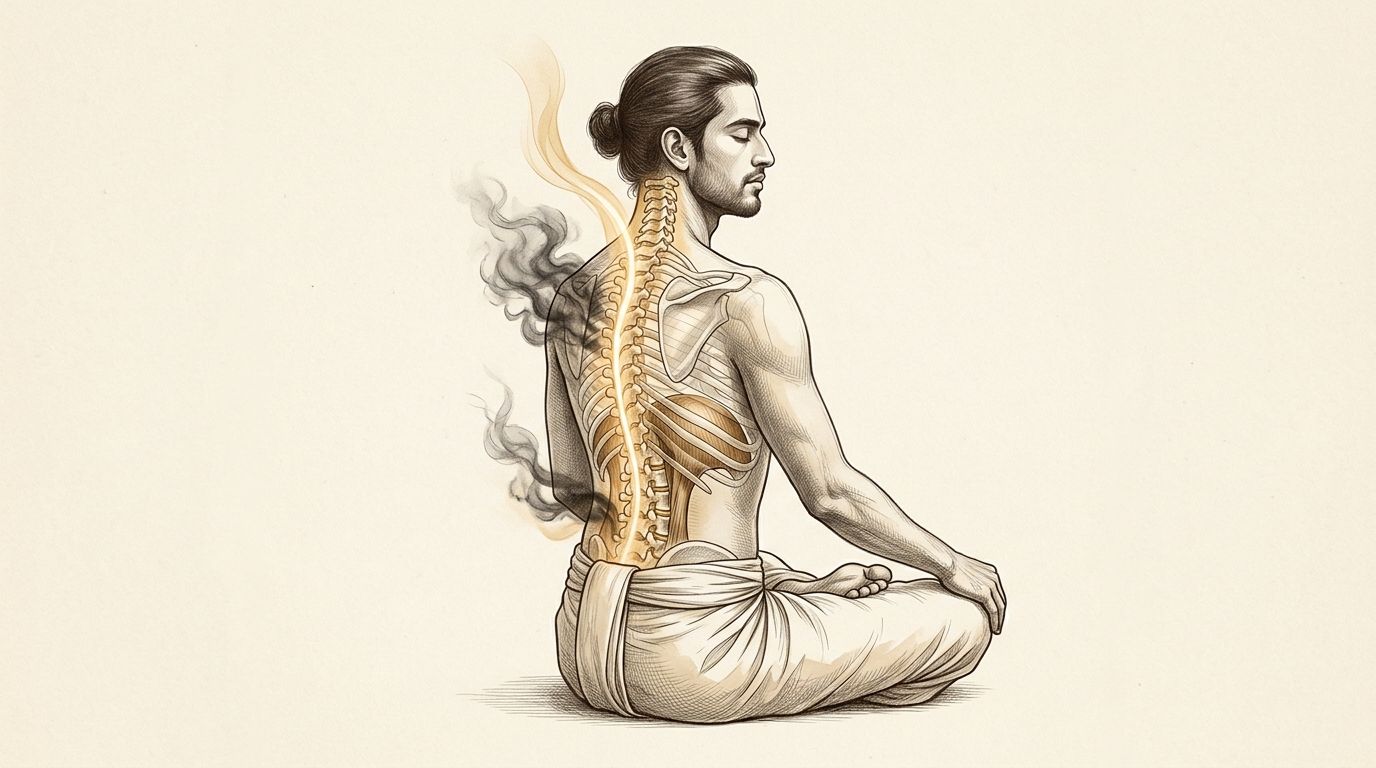
Why Your Spine Holds onto Old Emotional Pain: The Fascial Neuroscience and How Pranayama Sets You Free
Discover why the spine traps suppressed emotions through neuromuscular bracing, fascial armoring, and autonomic dysregulation, and learn how classical Pranayama decompresses vertebrae and restores emotional flow.
 Yoga Philosophy & History
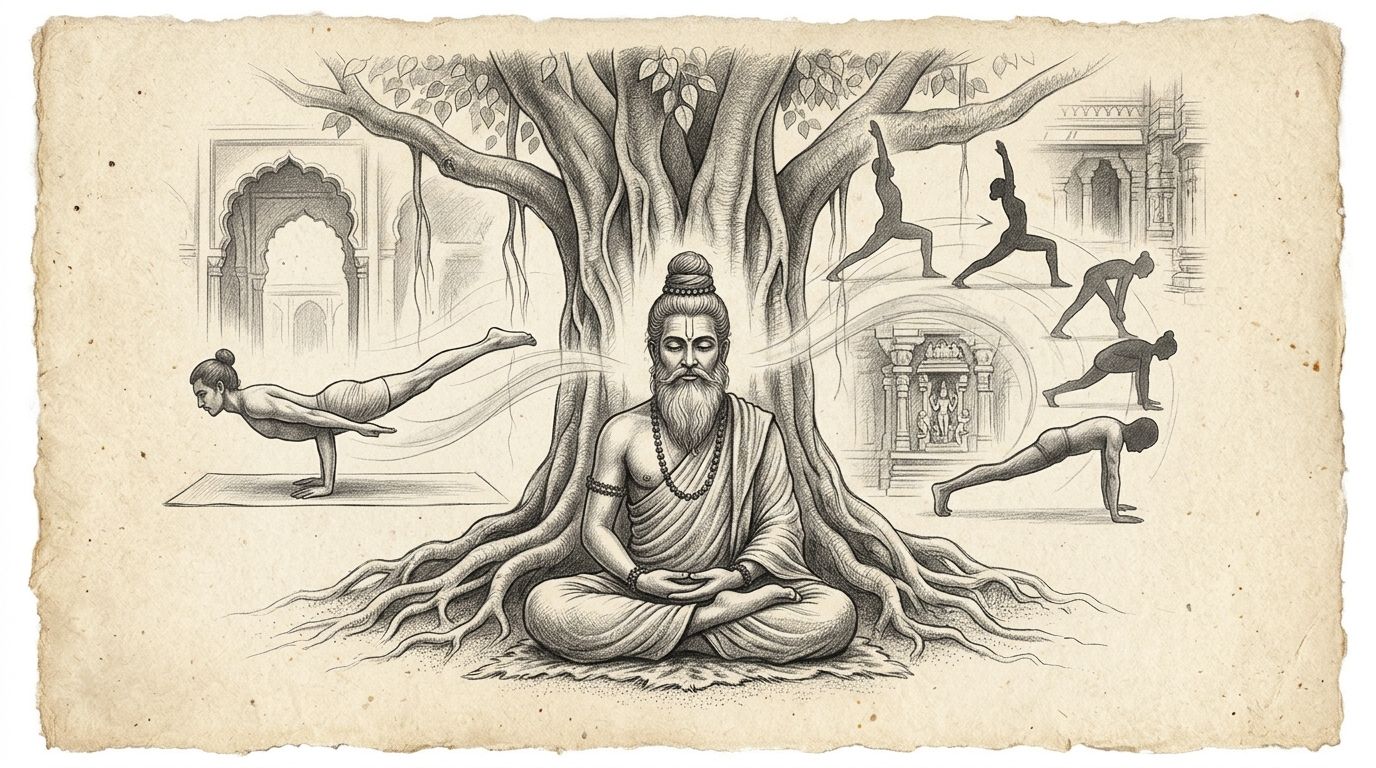
The Origins and Evolution of Yoga Asanas: From Ancient Meditation Seats to Modern Biomechanics
Explore the complete history and origins of yoga asanas. Discover how physical postures evolved from ancient seated meditation postures into medieval Hatha alchemical poses and modern dynamic Mysore Vinyasa systems.
 Yoga Pedagogy
Why Learn Yoga from an Indian Teacher: 9 Logical & Emotional Reasons for True Authenticity
Explore 9 compelling reasons why learning yoga from an Indian lineage teacher in India provides an authenticity, cultural depth, and nervous system transformation that commercial certifications abroad cannot replicate.