The Neurobiology of Nadi Shodhana: How Alternate Nostril Breathing Balances Brain Hemispheres and Resets the Autonomic Nervous System

How Does Nadi Shodhana Alternate Nostril Breathing Balance the Brain and Nervous System?
Nadi Shodhana alternate nostril breathing balances the brain and nervous system by regulating the body's ultradian nasal cycle, synchronizing cerebral hemispheres, and recalibrating autonomic tone:
- Hemispheric Synchronization: Airflow through the left nostril activates the right cerebral hemisphere (spatial calm, parasympathetic tone), while right-nostril airflow activates the left hemisphere (linear logic, sympathetic tone).
- Autonomic Recalibration: Alternating airflow across the nasal septum shifts the autonomic nervous system out of chronic sympathetic hyperarousal into restorative parasympathetic equilibrium.
- EEG Alpha Wave Enhancement: Clinical neuroimaging confirms that 5 to 10 minutes of slow alternate nostril breathing significantly elevates bilateral frontal EEG alpha wave power (8–12 Hz), quietening mental rumination without drowsiness.
- Neurochemical Homeostasis: Regular practice downregulates salivary cortisol, elevates Heart Rate Variability (HRV), and enhances vagal nerve tone.
The Invisible Rhythm in Your Nostrils
If you pay close attention to your breathing right now, you will notice a physiological reality that most people go their entire lives without realizing:
You are not breathing equally through both nostrils.
At this exact moment, one of your nostrils is open, clear, and conducting seventy to eighty percent of your incoming airflow, while the other is partially congested and resting in latency.
If you check again in ninety to one hundred and fifty minutes, you will discover that the airflow has reversed. The previously congested nostril is now dominant, and the open one has receded into resting latency.
This phenomenon is not a sign of allergies or sinus blockage. It is an innate biological chronorhythm known in modern medicine as the Ultradian Nasal Cycle.
Thousands of years before Western rhinologists documented this cycle with acoustic rhinometry, ancient masters mapped it with anatomical and energetic precision. They recognized that the flow of breath through each nostril directly dictates the state of your autonomic nervous system, the balance between your brain hemispheres, and the clarity of your consciousness.
To harmonize this rhythm, the sages codified Nadi Shodhana—commonly known in the West as alternate nostril breathing.
In this clinical and educational guide, we examine the neurobiology of nadi shodhana alternate nostril breathing, bridge ancient energy anatomy with modern neuroscience, and provide a progressive practice protocol to reset your nervous system and cultivate cognitive calm.
Ancient Energetic Anatomy: The Three Sacred Nadis
In classical yogic physiology, the subtle body is mapped as an intricate network of seventy-two thousand energetic channels called Nadis (from the Sanskrit root nad, meaning "flow" or "current").
Among these tens of thousands of pathways, three primary channels govern human physiology and consciousness:
1. Ida Nadi (The Lunar, Calming Channel)
Originating at the base of the spine and terminating at the left nostril, Ida represents the cooling, receptive, reflective lunar current (Chandra). Airflow through the left nostril directly activates parasympathetic nervous tone: lowering heart rate, calming blood pressure, enhancing digestion, and inducing mental quietude.
2. Pingala Nadi (The Solar, Activating Channel)
Originating on the right side of the pelvic floor and terminating at the right nostril, Pingala represents the heating, dynamic, analytical solar energy (Surya). Airflow through the right nostril stimulates sympathetic nervous activation: increasing metabolic rate, elevating blood glucose, sharpening linear logic, and preparing the body for focused action.
3. Sushumna Nadi (The Central Axis of Transcendence)
Running straight through the central spinal canal from the perineum to the crown of the head (Brahmarandhra), Sushumna is the neutral, transcendent channel of pure consciousness.
When breath flows erratically, consciousness swings back and forth between anxiety (hyperactive Pingala) and lethargy (congested Ida).
The ultimate objective of Nadi Shodhana (literally, "purification of the channels") is to balance the solar and lunar currents so that breath and awareness enter Sushumna Nadi, unlocking deep meditative absorption (Samadhi).
Modern Neuroscience: The Nasal Cycle and Brain Lateralization
In the late nineteenth century, German rhinologist Richard Kayser first documented the alternating congestion and decongestion of nasal erectile tissue, introducing the nasal cycle autonomic nervous system link to Western clinical medicine.
Subsequent research by neurophysiologists, notably Dr. David Shannahoff-Khalsa at the University of California, San Diego, revealed a direct correlation between the nasal cycle and contralateral cerebral dominance:
- Right Nostril Breathing Stimulates the Left Hemisphere:
When airflow dominates the right nostril, electroencephalogram (EEG) recordings show increased neural activity in the left cerebral hemisphere—the seat of verbal logic, mathematical reasoning, and linear problem-solving. This is accompanied by increased sympathetic tone and cardiovascular acceleration.
- Left Nostril Breathing Stimulates the Right Hemisphere:
When airflow dominates the left nostril, EEG activity shifts toward the right cerebral hemisphere—the center of spatial awareness, holistic pattern recognition, emotional processing, and creative intuition. Concurrently, vagal parasympathetic activity increases, calming the heart and lowering cortisol.
When you practice nadi shodhana alternate nostril breathing, you are not merely engaging in relaxation; you are conducting precise, mechanical hemispheric synchronization. By alternating airflow across the nasal septum every few breaths, you balance left-brain logic with right-brain spatial calm, eliminating mental fog and emotional reactivity.
Master Comparison: Ida, Pingala, and Sushumna vs. Neurobiology
EEG Alpha Waves: The Signature of Effortless Presence
What happens inside the brain when you practice alternate nostril breathing?
Clinical neuroimaging research published in the National Institutes of Health PubMed Central database on EEG changes during pranayama demonstrates that slow, controlled alternate nostril breathing induces a marked increase in bilateral frontal EEG alpha wave power (8 to 12 Hz).
Alpha waves represent the neurological state of "relaxed alertness."
When you are stressed or overthinking, your brain is flooded with high-frequency Beta waves (13 to 30 Hz), reflecting an overactive Default Mode Network (DMN), as explored in our guide on The Secrets of Overthinking and How to Stop It. Conversely, when you are exhausted or depressed, your brain sinks into slow Theta or Delta waves.
Alpha waves bridge the gap: they down-regulate the restless Default Mode Network without causing drowsiness. This allows practitioners to experience profound cognitive spaciousness—a state where the mind is peaceful yet intensely clear and focused.
The Classical Sutra Perspective: Breaking the Habitual Momentum of Breath
In the foundational text of classical yoga, Patanjali introduces Pranayama as the fourth limb of Ashtanga Yoga, defining it with surgical clarity in Sutra 2.49:
"Tasmin sati shvasa-prashvasayor-gativicchedah pranayamah"
— Yoga Sutras 2.49
(That being accomplished, pranayama is the cessation or intentional regulation of the habitual movements of inhalation and exhalation.)
Notice Patanjali's phrasing: gati-vicchedah—the cutting or breaking (vicchedah) of the habitual, uncontrolled momentum (gati) of ordinary breath.
In everyday life, our breathing is completely hijacked by unconscious emotional reactions. When an anxious email arrives, breathing becomes rapid and shallow. When anger strikes, breath turns ragged. This erratic breath constantly agitates the mind (Chitta).
In Sutra 2.52, Patanjali reveals the profound consequence of mastering this regulation:
"Tatah kshiyate prakasha-avaranam"
— Yoga Sutras 2.52
(Thence is dissolved the covering over the inner light of discernment.)
The classical commentary explains that the mind naturally possesses luminous clarity (Sattva). However, this inner light is chronically veiled (avaranam) by the dust of Rajas (restless agitation) and Tamas (mental lethargy).
Classical yogic psychology maps the mind into five distinct states (Chitta-Bhumis):
- Kshipta: Scattered, restless, anxious.
- Mudha: Dull, heavy, lethargic.
- Vikshipta: Intermittently focused, easily distracted.
- Ekagra: One-pointed, deeply concentrated.
- Niruddha: Completely stilled, absorbed in the witness.
Most modern professionals spend their days swinging between Kshipta (workplace anxiety) and Mudha (exhausted screen fatigue).
The ancient sages taught that the river of mind flows wherever the breath directs it. When the breath is erratic, the river surges into the canyons of worry.
By practicing Nadi Shodhana with Abhyasa (patient, daily consistency) and Vairagya (dispassionate presence), you clear the covering over the mind, guiding consciousness out of Vikshipta into the serene stillness of Ekagra.
Physiological Benefits: Why Clinical Science Supports Nadi Shodhana
Clinical studies examining the systemic benefits of regular alternate nostril breathing confirm widespread therapeutic effects:
1. Autonomic Blood Pressure Regulation
Controlled clinical trials published by Frontiers in Human Neuroscience on yogic breathing and autonomic control show that just ten minutes of slow alternate nostril breathing significantly reduces resting systolic blood pressure and heart rate in individuals with mild hypertension.
2. Vagal Nerve Tone & Heart Rate Variability (HRV)
By extending the exhalation phase through the left nostril, Nadi Shodhana stimulates the vagal brake, dramatically increasing Heart Rate Variability (HRV)—the clinical gold standard of cardiovascular resilience and autonomic adaptability, as detailed in our guide on How Yoga Breathing Calms Your Nervous System and our comprehensive clinical review on The Science of Classical Pranayama & Modern Research.
3. Reduction of Subjective Stress & Cortisol
Salivary cortisol tests confirm that practitioners engaging in daily alternate nostril breathing exhibit lower baseline levels of systemic stress hormones, reversing chronic adrenal strain.
4. Integration with Functional Asana Biomechanics
Breathwork directly interacts with the musculoskeletal container. Diaphragmatic alternate breathing eases chronic tension held in the pelvic floor and spinal stabilizers, supporting core integration as taught in the Ashtanga Yoga Tristhana Method.
Step-by-Step Practice Protocol: How to Practice Nadi Shodhana Safely
To reap the full neurological and energetic benefits of nadi shodhana alternate nostril breathing, practice with proper seated posture and progressive stages:
Step 1: Establish Sthira-Sukham Asanam
Sit comfortably with an upright, elongated spine in Sukhasana, Ardha Padmasana, or on a firm chair with feet flat. Elevate your hips on a cushion so your knees rest below your hip points, preventing spinal collapse, as outlined in our study on The Seven Dimensions of Padmasana.
Step 2: Form Nasika Mudra
Rest your left hand on your left knee in Jnana Mudra (index finger touching thumb). Bring your right hand to your face, folding the index and middle fingers into your palm (Nasika Mudra). Use your right thumb to gently control the right nostril, and your right ring finger to control the left nostril.
Step 3: Stage 1 — Gentle Inhalation and Exhalation (Ratio 1:1)
- Close the right nostril with your thumb. Exhale completely and smoothly through the left nostril.
- Inhale slowly through the left nostril for a count of 4.
- Close the left nostril with your ring finger, release your thumb, and exhale smoothly through the right nostril for a count of 4.
- Inhale through the right nostril for a count of 4.
- Close the right nostril, release the left, and exhale through the left nostril for a count of 4.
- This completes one full round. Practice 6 to 10 rounds at an unhurried, comfortable pace.
Step 4: Stage 2 — Extending the Exhalation (Ratio 1:2)
Once comfortable with equal breathing, begin lengthening the exhalation to double the duration of the inhalation (inhale for 4 counts, exhale for 8 counts). This extended exhalation triggers profound vagal nerve stimulation.
Step 5: Stage 3 — Classical Kumbhaka (Breath Retention)
In traditional Yogashala lineage study, Kumbhaka (internal and external retention) is introduced only after months of preparatory practice and under the direct supervision of an experienced teacher. Never force breath retention if you experience dizziness, anxiety, or air hunger.
Integrating Pranayama into a Complete Yogic Life
Pranayama was never intended to be practiced as an isolated five-minute biohack. In classical Yogashala lineage tradition, breathwork is woven seamlessly into a complete sadhana alongside ethical discipline (Yama and Niyama), functional asana, and meditation, as explored in How Vedanta Philosophy Complements Physical Yoga Practice.
Anchoring your breathwork within The Ultimate Daily Morning Yoga Sadhana Routine ensures that the neurological balance cultivated on the cushion radiates through your entire workday.
To understand how traditional breathwork and functional biomechanics are taught in authentic residential lineage programs, explore our guides on The True Cost of a Yoga Teacher Training in India, How to Choose a Yoga School in India: Red Flags vs. Authentic Lineage, and Why Learn Yoga from an Indian Teacher.
Frequently Asked Questions
What is the difference between Nadi Shodhana and Anulom Vilom?
In contemporary practice, Anulom Vilom typically refers to basic alternate nostril breathing practiced without breath retention (Kumbhaka), focusing on rhythmic 1:1 or 1:2 breathing. Classical Nadi Shodhana, as described in the Hatha Yoga Pradipika, includes precise bandhas (Jalandhara, Mula, and Uddiyana Bandha), mantras, and timed internal and external breath retentions taught under teacher guidance.
Can Nadi Shodhana help with acute anxiety and panic attacks?
Yes. By prolonging the exhalation through the left nostril, Nadi Shodhana mechanically stimulates the vagus nerve, signaling the sinoatrial node of the heart to slow down. This immediately interrupts the sympathetic adrenaline cascade and down-regulates the amygdala within 3 to 5 minutes of practice.
What is the best time of day to practice alternate nostril breathing?
The most potent time is during Sandhya—the junction points of the day, specifically at dawn during Brahma Muhurta or at dusk before sunset. It is best practiced on an empty stomach after asana practice and prior to meditation.
Why is one nostril blocked when I wake up in the morning?
This is the natural Ultradian Nasal Cycle at work. Nasal erectile tissue alternates between engorgement and decongestion every 90 to 150 minutes under hypothalamic autonomic control. It only indicates an issue if one side remains chronically blocked for days without alternating.
Is Nadi Shodhana safe for beginners to practice daily?
Yes, Stage 1 (equal 1:1 breathing without breath retention) is safe and restorative for everyone, including those with hypertension or anxiety. Advanced stages involving prolonged breath retention (Kumbhaka) should only be undertaken under qualified lineage instruction.
Experiencing the Living Science at Samyut Yogashala Mysore
At our residential Samyut Yogashala shala in Mysore, India, yoga is taught as an integrative science of human liberation. Under authentic lineage teachers, you will immerse yourself in functional biomechanics, classical pranayama, somatic release, and living philosophy.
Begin your personal journey from technique into self-mastery through our residential 200-Hour Ashtanga Yoga Teacher Training in Mysore and Classical Hatha Yoga Teacher Training, or connect with our international seeker family through the Samyut Sangha Community.
Yogacharya Aravind Prasad
E-RYT 500 · YACEP · Founder, Samyut Yoga
Gurukulam-trained in Yoga, Veda and Vedanta with 15+ years of teaching experience. Founder of Samyut Yoga, Mysore.
Join Samyutam — The Spiritual Sadhana Sangha
Move beyond posture. Study Vedanta philosophy, master Sanskrit, and practice traditional pranayama and Tantric meditation under authentic lineage guidance.
Apply to Join the SanghaRelated Articles & Insights
 Practice of Raja Yoga
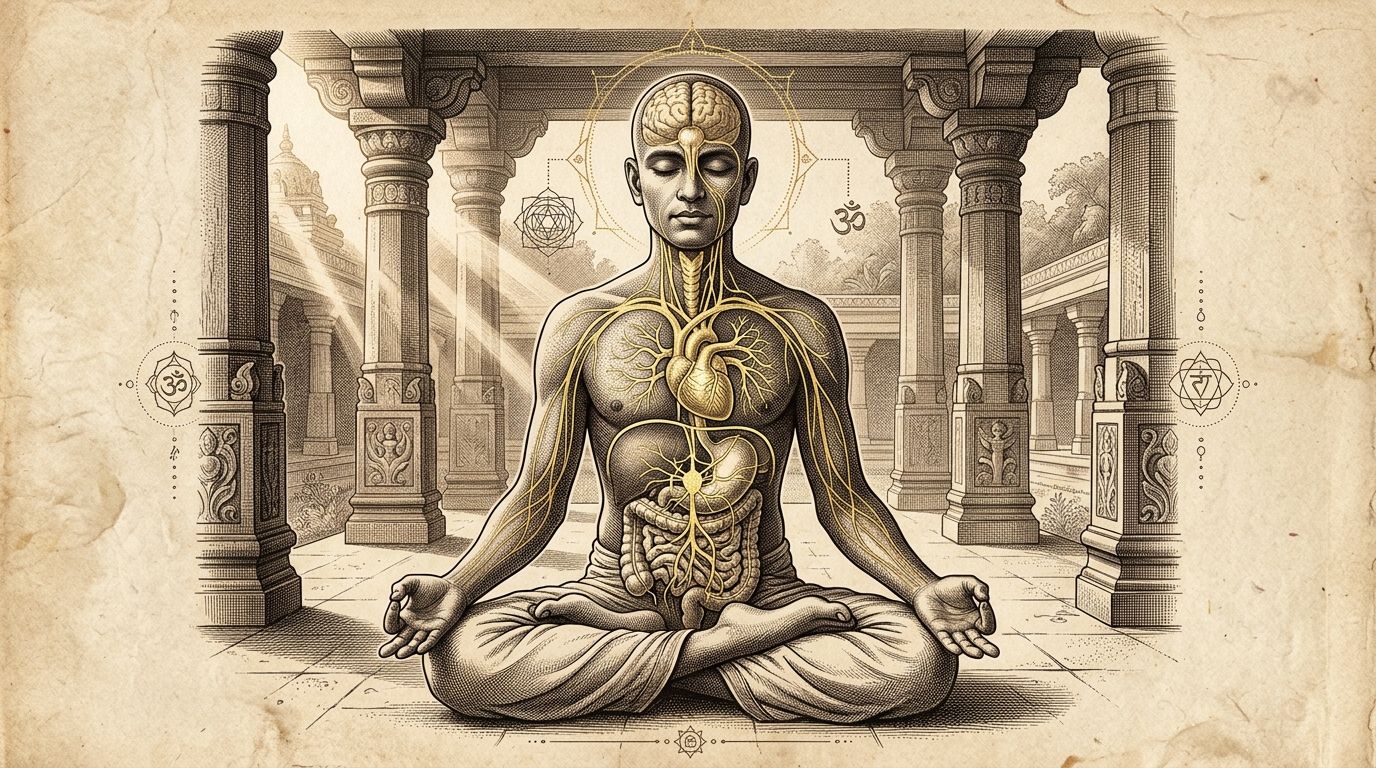
How Yoga Breathing Calms Your Nervous System: A Simple Guide to the Vagus Nerve and Ancient Pranayama
Discover how simple yoga breathing stimulates the vagus nerve, releases nitric oxide, and restores Heart Rate Variability (HRV) to shift your body out of chronic stress into deep calm.
 Practice of Raja Yoga
The Ultimate Daily Morning Yoga Sadhana Routine: Classical Dinacharya, Pranayama & Asana Sequence
Discover how to establish a transformative daily morning yoga sadhana routine at home. Learn classical Brahma Muhurta timing, Dinacharya cleansing, Pranayama, Asana, and meditation.
 Raja Yoga
Why is Mysore Considered the Global Capital of Ashtanga Yoga?
Explore the royal history, lineage of T. Krishnamacharya and Sri K. Pattabhi Jois, neurobiology of Tristhana, and why Mysore remains the undisputed global capital of Ashtanga Yoga.