

Content of this Blog
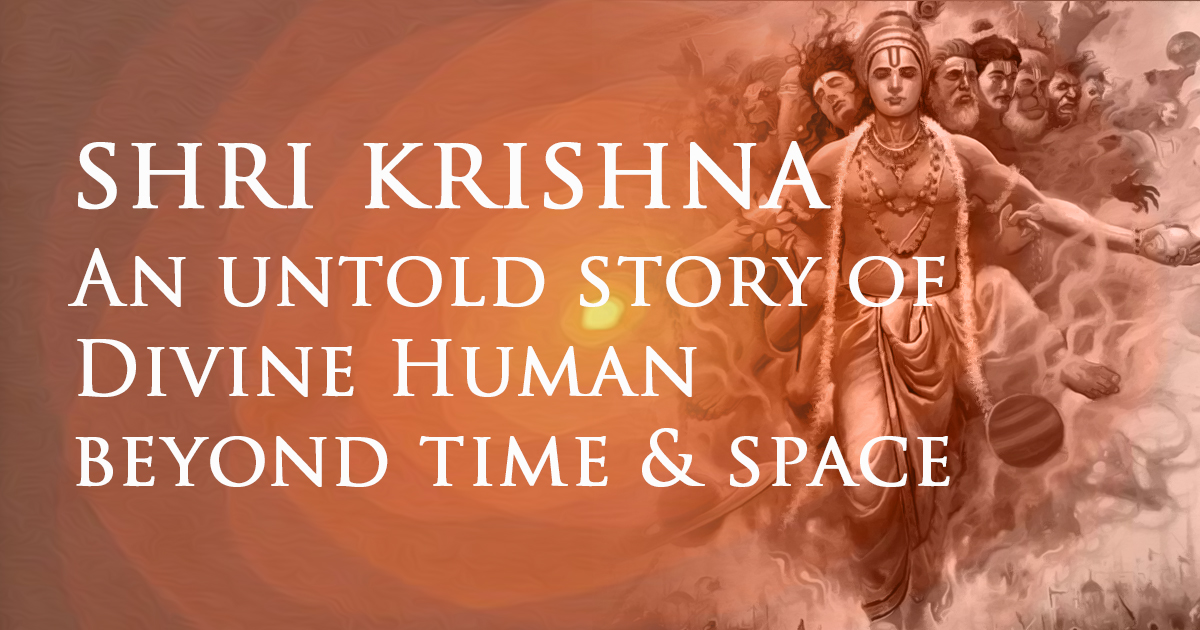
Shri Krishna Janmashtami is a popular festival filled with joy, devotion, and deep spirituality. But beyond the well-known stories and rituals surrounding Shri Krishna, a different story lies untold – one laden with profound symbols, hidden messages and cosmic importance.
The Cosmic Timing: The Birth of a Savior
Krishna’s birth at midnight in King Kamsa’s prison has a lot of meaning attached to it. Midnight is when darkness turns into light, ignorance into knowledge – it marks the moment when spiritual awakening occurs within an individual’s soul, where egoism and materialism transcend into divine consciousness.
The Prison: A Metaphor for Human Life
One of the most symbolic elements of Krishna’s tale was his birth in a jail cell. The prison represents the world of matter that entraps the soul in bonds of karma, limitation, desire and ignorance.
Krishna’s parents Vasudeva and Devaki symbolize the individual soul bound by the limitations of this worldly existence with its inherent possibilities for divinity.
In the Flow of Grace: The Great River Yamuna
The story of Vasudeva’s crossing over the Yamuna to get Krishna safely to Gokula is one aspect of the birth stories of Krishna that is little known.
For this reason, we associate it with divine grace which assists each soul in coping with life’s trials which help us towards transformation and growth.
Divine Manifestation - The Significance
As Janmashtami approaches, it’s important to know the deeper aspects of Krishna’s personality that make him not just an avatar, but a figure who transcends the boundaries of time, space, and scientific understanding.
What makes Krishna so extraordinary? The answer lies in the 16 Kalās, or 16 divine attributes, that he embodies. These Kalās represent the perfection of existence, consciousness, and energy—concepts that modern science is only beginning to understand.
The 16 Divine Attributes - Journey from Human to Superhuman
Annamaya: The Physical Manifestation
Krishna’s Annamaya Kalā represents his perfect physical form, sustained by food and material energy. In scientific terms, this can be seen as the optimal expression of biological existence—a body perfectly adapted to its environment, capable of extraordinary accomplishments.
Krishna’s physical adventures, such as lifting Govardhan Hill and dancing on Kaliya the serpent, showcase a superhuman strength that modern physics might attribute to a being in perfect harmony with the forces of nature.
Pranamaya: The Vital Life Force
Pranamaya refers to the life force, or prana, that sustains the physical body. For Krishna, this is more than just breath; it’s the divine will that drives all life processes.
Consider it akin to the bioelectric field that modern science is beginning to explore—the idea that life is sustained by an electromagnetic energy field governing cellular function.
Krishna, with his infinite Prana, symbolizes the ultimate source of life energy, far beyond what any scientific instrument can measure.
Manomaya: Mastery of Mind and Emotion
Manomaya Kalā represents the mind—thoughts, emotions, and desires. Krishna’s control over his mind and emotions was unparalleled, enabling him to maintain equanimity in the most chaotic situations.
Modern neuroscience discusses neuroplasticity, the brain’s ability to rewire itself. Krishna’s mastery of his mind suggests a level of neuroplasticity that allows complete control over emotions and thoughts, a state that humans can aspire to achieve through Yoga Sadhana.
Vijnanamaya: The Intellectual Brilliance
Krishna’s Vijnanamaya Kalā represents his profound wisdom and intellectual capacity. Scientifically, this is comparable to a supercomputer, processing vast amounts of information at lightning speed.
His teachings in the Bhagavad Gita are not just spiritual but intellectual masterpieces, demonstrating an understanding of the universe that transcends human knowledge.
Anandamaya: The Blissful State
Anandamaya is the state of pure, unadulterated bliss. From a psychological perspective, this is the state of self-actualization, where a being reaches the pinnacle of spiritual and personal fulfillment.
Krishna, in his Ananda, symbolizes the ultimate goal of human life—a state of perpetual joy that modern psychology identifies as the highest form of mental well-being.
Atimānsā: The Transcendental Consciousness
Atimānsā refers to Krishna’s transcendence of ordinary consciousness. In quantum physics, scientists discuss the observer effect, where observation influences the behavior of particles. Krishna’s consciousness is similar to the ultimate observer, whose awareness shapes reality itself.
Shraddha: The Power of Sincere Aspiration
Shraddha represents sincere aspiration or strong willpower, a force often overlooked by modern science but with profound implications. Placebo studies show that willpower or belief alone can trigger real physiological changes in the body.
Krishna, as an embodiment of Shraddha, suggests a being whose mere will to manifest in the divine order is so powerful that it shapes reality, reinforcing the idea that Shraddha is not just psychological but also a physical force.
Sarvashakti: The Omnipotent
Sarvashakti is the all-encompassing powerful force manifesting as Krishna. This can be compared to the unified field theory in physics—the idea that all forces in the universe are interconnected.
Krishna is the ultimate source of all energy, much like the unified field that modern physicists seek to understand.
Sarvakaamadugha: Fulfiller of All Desires
Sarvakaamadugha refers to Krishna’s ability to fulfill the desires of all beings. In the scientific context, this parallels the law of attraction, where focused intention brings about desired outcomes. Krishna, with his perfect understanding of this law, can manifest reality at will.
Brahmavarchas: The Divine Radiance
Brahmavarchas symbolizes the radiance of divine consciousness. This can be likened to biophotons—the light particles emitted by living organisms. Krishna’s divine radiance is not just a metaphor but a real phenomenon, representing his high vibrational energy, visible to those with heightened awareness.
Sarvagamana: The Omnipresent
Sarvagamana refers to Krishna’s omnipresence. In modern terms, this is similar to quantum entanglement, where particles are connected across vast distances, affecting each other instantaneously.
Krishna’s presence in every atom and molecule of the universe mirrors this scientific principle, suggesting that his essence is intertwined with the fabric of reality.
Purnatva: The State of Completeness
Purnatva represents completeness or wholeness, a state of being that is self-sufficient and fulfilled. This can be seen as the theory of everything in science—the idea that there is a single, unified theory that explains all physical aspects of the universe.
Krishna, in his Purnatva, embodies this ultimate state of completeness, where all dualities merge into one.
Sarvajnatva: The Omniscience
Sarvajnatva refers to omniscience—the ability to know everything. This can be compared to information theory, where all data in the universe is interconnected.
Krishna’s omniscience suggests a being who has access to all information across time and space, a concept that stretches the limits of human understanding.
Sarvakartrtva: The Ultimate Doer
Sarvakartrtva means being the ultimate doer—the one behind all actions. This can be related to determinism in science, where every event is determined by preceding events.
Krishna, as the ultimate cause, orchestrates the cosmic dance, influencing all actions and reactions in the universe.
Sarvaadhaaratva: The Universal Support
Sarvadharatva is the attribute of supporting everything in existence. This is akin to the cosmological constant in physics—the energy that keeps the universe stable.
Krishna’s role as the supporter of all creation can be seen as the spiritual counterpart to this scientific principle, maintaining balance and order in the cosmos.
Sarvantaryamitva: The Unmanifested Waiting to Manifest
Finally, Sarvantaryamitva refers to Krishna’s presence within every being as the inner divinity, waiting for your call and aspiration to manifest.
Krishna’s presence within each of us is a reminder that we are all part of a greater whole, guided by his divine will.
The Ultimate Lesson: Krishna’s Birth Within Us
The untold story of Krishna Janmashtami is that Krishna’s birth is not just an event that happened thousands of years ago; it’s an event that can happen within each of us.
The prison, the river—these aren’t just external events, but inner experiences that each of us can relate to on our spiritual journey from being limited by time and space to going beyond those limitations.
This is the story of the soul’s journey from darkness to light, from bondage to liberation, from ignorance to divine knowledge. In Krishna, we find the ultimate expression of what it means to be truly alive, truly conscious, and truly divine.
As we meditate on his life and teachings, we can aspire to awaken these Kalās within ourselves, moving closer to the divine perfection that he embodies.